

Beyond HRV
Life begins and ends at the cellular level.
Lifestyles are determined by habit. The most insidious aspect of habit is its ability to dull awareness. This is when the mayhem begins…
The technology now exists to extract voluminous information from our heart, not just how fast it beats. Tiina Hoffman, an exercise physiologist at Firstbeat, explains how we can turn heart rate variability data into insights into stress, recovery, and exercise.
Please visit Firstbeat Sports to learn more about comprehensive analytics for optimizing endurance sports performance. We use clinical-grade devices backed by more than 25 years of research and testing for wellness/longevity and endurance sports performance.
Optimal performance at work, in sport, and in life can be quite a balancing act: staying resilient and coping with a multitude of life’s demands, while trying to optimize lifestyle guidelines – eat well, keep hydrated, exercise, recover, and sleep.
This balancing act is not an easy equation to solve, but it has opened the way for a wide range of technological solutions, devices, and apps to help us manage stress and perform at the top of our game. The positive influence of a balanced lifestyle on health and performance is supported by extensive scientific evidence.
The literature indicates that appropriate physical activity and good-quality sleep support recovery from day-to-day and long-term stressors and contribute positively to one’s well-being.

Heart rate variability (HRV) is the physiological phenomenon of the variation in time between consecutive heartbeats.
Heart rate variability [HRV] is the physiological phenomenon of the variation in the time interval between consecutive heartbeats. The level of HRV varies widely between individuals, but, in general, high HRV is considered a marker of reasonable fitness and health. In contrast, low HRV is associated with a range of adverse health outcomes and stress.
This article describes a method for analyzing heart rate variability to conclude essential lifestyle factors. The technique, developed by Firstbeat Technologies Oy, is based on advanced mathematical modelling, with empirical physiological and behavioral research in the background.
The principle is to use heart rate responses and heart rate variability to assess stress, recovery, sleep quality, and physical activity in daily life. The method is considered a tool for professionals and can be used in corporate wellness, preventive occupational healthcare, lifestyle coaching, and in a broad range of sports settings.
The Autonomic Nervous System and HRV
The autonomic nervous system [ANS], consisting of the sympathetic and parasympathetic branches, works behind the scenes to regulate a wide range of physiological functions that we have relatively minimal conscious control over, but are necessary to maintain life and performance across a diverse set of activities and demands.
The sympathetic branch [SNS] is regarded as the “fight or flight” system, getting us ready to act, react, and perform. At the same time, the parasympathetic side [PNS] is often characterized as the “rest and digest” system. Both systems typically function simultaneously, but in opposition to each other, either activating or inhibiting specific physiological responses.
The role of the ANS is undeniable with the heart. When the body is faced with stress, the ANS kicks in by activating stress hormone production and increasing the rate and force of contraction of the heart [cardiac output]. For example, after stress or exercise, parasympathetic stimulation decreases heart rate to restore homeostasis.
Measuring the heart at beat-by-beat accuracy provides us with a vast amount of information about the body. It is commonly accepted as a non-invasive marker of autonomic nervous system activity. It serves as a powerful tool for observing the activity levels and interplay between the sympathetic and parasympathetic systems.
A variety of physiological phenomena affect HRV levels. For example, inhalation and exhalation [a symptom known as respiratory sinus arrhythmia (RSA): heart rate increases, and HRV decreases during inhalation, whereas heart rate decreases and HRV increases during exhalation], hormonal reactions, metabolic processes, exercise, movement, cognitive processes, stress, and recovery.

HRV should naturally increase during relaxed activities, especially during sleep, when parasympathetic [vagal] activation increases. HRV decreases during stress, when sympathetic activity helps the body to keep pace with demand. HRV is typically higher when the heart beats slowly and lower when it beats faster.
HRV changes naturally with activity and stress levels. If a person is chronically stressed or overloaded [physically or mentally], the interplay often disrupts the two systems, with the sympathetic system predominating, resulting in low HRV metrics.
In athletes, long-term overload due to an imbalance between training (too much and/or too intensively) and other life stressors, versus sufficient recovery, is known as overtraining.
Studies suggest that overtraining is often characterized by increased activation of the cardiorespiratory and sympathetic nervous systems and a lowered HRV. In addition to overload and external stress, internal stress factors, such as poor nutrition, alcohol consumption, and various illnesses, can reduce HRV.
Genetic factors account for about 30% of the variance in HRV. Still, higher HRV is generally considered an indicator of a healthy heart, reduced morbidity and mortality, psychological well-being, and quality of life. A person can increase their HRV levels by improving their health and fitness via lifestyle changes.
Lifestyle Insights
The Firstbeat analysis method recognizes different bodily states from the measured heart rate variability data by converting the heartbeats, via a sequence of calculations, into reports that illustrate what daily events cause stress or promote recovery, how good the quality of sleep is, and whether the days include exercise that provides positive health and fitness effects.
The calculation process uses HRV data to estimate, for example, oxygen uptake, respiration, and energy expenditure, and to determine a reliable individual baseline and physiological range for each person, before producing results and conclusions.
To solidify the connection between the HRV data and the person’s behaviors, a journal of key events is kept during the measurement, and these events are shown on the report. A stress state signifies dominance of the sympathetic nervous system and includes positive and negative stress reactions, whereas recovery means parasympathetic dominance.
The key is not to eliminate stress but to strive for a balance between the two branches of the ANS. The fixation solely on the HRV score is erroneous. Think ANS modulation because stress is ever-present.
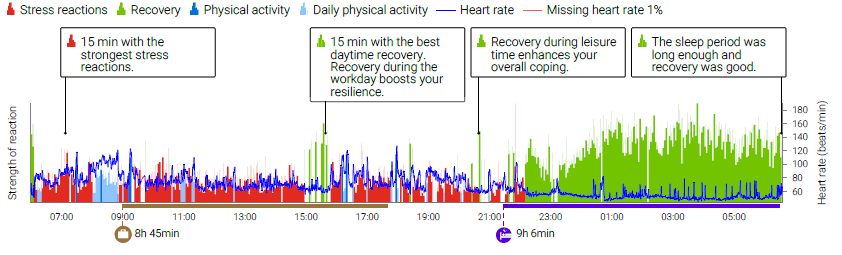
Designed as a tool for professionals, the method allows the personal trainer or wellness specialist to ‘see beneath the surface’ and provide evidence-based coaching to help the clients take charge of their own well-being and make lasting lifestyle and behavioral changes.
Professional interpretation and discussion between the coach and client typically focus on topics such as stress management, sleep and recovery strategies, balanced nutrition, sensible drinking habits, a balanced training program, improved fitness, and greater overall resilience.
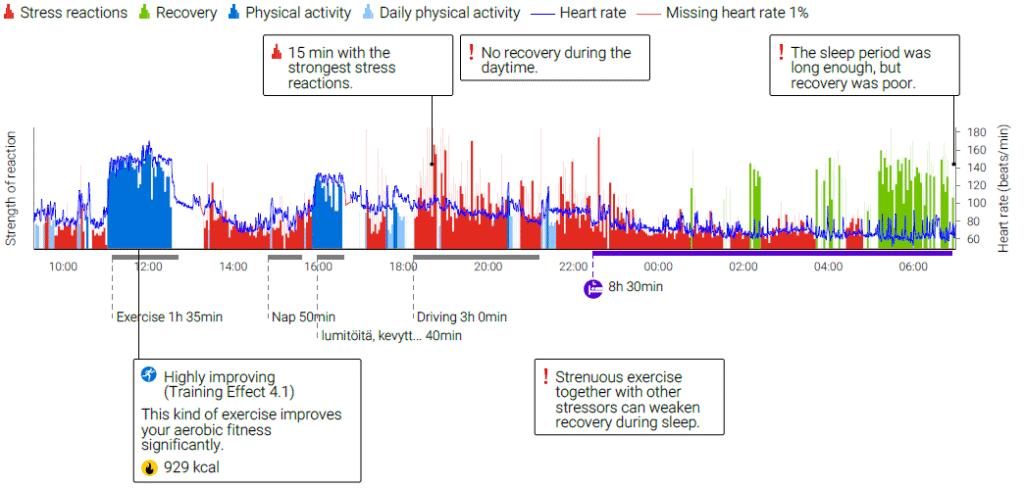
A common discovery that people make is how alcohol can worsen their sleep quality, particularly when combined with other stressors, such as a heavy workload or intense exercise. A clear dose-response relationship has been found, with the adverse effects on sleep building up after just one to two units.
Fitness enthusiasts are often surprised to find out how much a high-intensity workout in the evening impacts the sleep cycle. It is not a message to stop exercising, but to be aware of how much strenuous exercise loads the body and to pay better attention to intensity levels and recovery to optimize sleep. Figures 1 and 2 show two real-life examples of personal insights gained from the report.
Case – Senior Manager
This case examines a senior manager working in a high-profile banking role in London. The lifestyle measurements were conducted by Optima-Life as part of their “Perform @ Your Peak Program”, and Simon Shepard, CEO of OptimaLife, has provided the insights for this case.
The first assessment establishes a baseline and looks at “Energy and Performance,” and the second assessment is a follow-up. The workshops and coaching that form part of the program look at several factors that influence personal resilience.
Diet, exercise, and sleep are the obvious ones. Still, relationships, value alignment, focus, and a positive mindset can also lead to changes in one’s ability to recover, perform, and cope with the load of life.
Measurement 1 – As seen in graph one above, minimal recovery was observed in the manager’s results over the 3-day measurement period, and there were many stress reactions during sleep. This left her resources depleted. The client acknowledged having a busy life, often neglecting to take care of herself or to allow time for sufficient rest or recuperative activity.
Lunch was often taken on the run, hydration was ignored, and there was little formality seen in trying to ‘switch off’ from work at the end of the day. The data was used to show how her behaviors were affecting her physiology and this proved to be a catalyst in creating a mindset shift.
The process helped give her permission to look after herself, take positive actions in critical areas, and ultimately to re-energize her life.
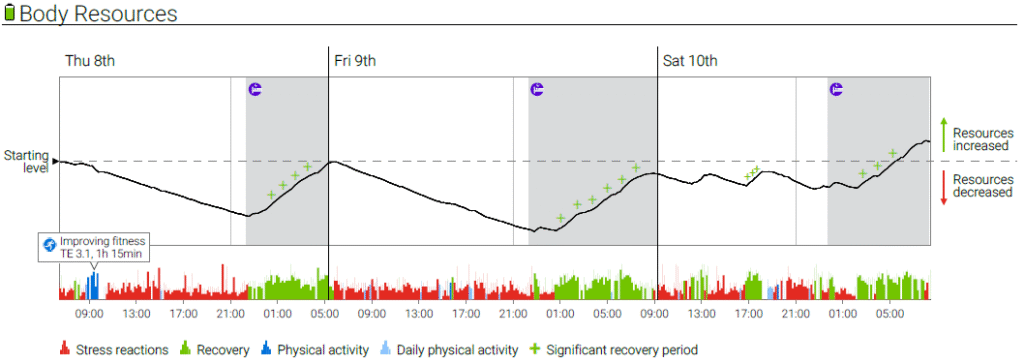
Measurement 2 – The amount and quality of recovery during sleep had improved significantly, and the consumed resources were now being replenished during sleep. The client began to create recovery time and monitor hydration and dietary habits. She felt more energized, more productive, and more purposeful at work and at home [graph 2].
HRV is linked to cellular phenomena ranging from electrical impulses in cardiac cells to neurotransmitters that regulate the body. HRV is discussed in terms of the autonomic nervous system, but it is ultimately the product of complex, non-linear dynamics that start at the cellular level.
Cellular Impact:
→ Pacemaker cell dynamics. At the most fundamental level, HRV is generated by fluctuations in the firing rate of the heart’s pacemaker cells, located in the sinoatrial [SA] node. Research using isolated cardiac cells has shown that intrinsic cellular mechanisms, such as ion channel turnover and stochastic gating of ion currents, can influence beat-to-beat variability.
This means that even in the absence of external nerve signals, cardiac tissue can exhibit complex, power-law-like variability;
→ Autonomic signal reception. The autonomic nervous system influences HRV by releasing neurotransmitters like acetylcholine [from the parasympathetic vagus nerve] and norepinephrine [from the sympathetic nervous system].
These neurotransmitters bind to muscarinic and adrenergic receptors on the surface of cardiac cells, altering the flow of ions [potassium and calcium]and, in turn, affecting the heart’s rhythm. This is the primary mechanism by which the brain and nervous system modulate HRV;
→ Inflammation. At the cellular level, a decrease in HRV is associated with higher inflammation. The vagus nerve, which increases HRV by promoting a “rest and digest” state, also has an anti-inflammatory effect by downregulating cytokine release. Conversely, cellular stress and an increase in pro-inflammatory cells, like M1 monocytes, are linked to lower HRV;
→ Beta-cell function in diabetes. Studies have found that lower HRV is associated with poorer beta-cell function in the pancreas. Beta cells are responsible for insulin production, and the observed link suggests that autonomic nervous system dysfunction, reflected by low HRV, can disrupt the cellular mechanisms that regulate glucose metabolism.

Nutshell
→ Systemic metabolic processes. Chronic and acute metabolic changes, such as those seen in diabetes and related to lipid metabolism, also have cellular effects on HRV. Alterations in glucose and insulin levels have been shown to reduce HRV parameters, highlighting the systemic and cellular-level impact of these metabolic factors.
Heart rate variability provides a non-invasive window into autonomic nervous system activity, health, and fitness. The method described here is based on constructing a physiological model of an individual using real heartbeat data.
This data can be used to assess stress, recovery, and exercise, and to gauge how the body is coping overall. In a broader professional context, this provides a powerful preventative tool for lifestyle and wellness coaching to help people make meaningful lifestyle and behavioral changes.
Growth has no endpoint…
We have the technology to eliminate guesswork, decode superhuman, and propel your limitless potential. Challenge yourself today to boldly manifest the keys to your mansion of unparalleled health, performance, and longevity.
A limitless life is a choice…
Find more information at Performance Medicine™.
Schedule a FREE CONSULTATION via the blue widget, our contact form, or 401.207.4215.