
The Amazing Story of “Save Our Monarchs”
Sometime more than a million years ago, the Monarch Butterfly appeared in the American tropics (areas now known as Central America/Mexico). It must have been a happy time for them.
They were forced to travel north eons later, as the glaciers started melting approximately 20,000 years ago. Why? Because milkweed, their daily diet, moved with the receding glaciers.
(Monarchs migrate up to 3,000 miles from Canada and the U.S.A. to central Mexico each fall) {These highlights courtesy of The Farmer’s Almanac}
However, the species never lost its instinct to overwinter further south. And that’s the problem. Think of it this way: There is a long interstate highway going from North America to Mexico. You stop, eat, gas up, and move on. Then, you start to notice over the years that restaurants are gone, grocery stores are gone, and gas stations are few and far between. Those are obstacles Monarchs are struggling to overcome.
The biggest problem comes from neonicotinoid-treated seeds, which “are most often applied in row crop agriculture as a preventative seed treatment.” The plant, leaves, roots, nectar, and pollen “become irreversibly toxic to insects . . . leaching into the soil and water . . . impacting wildflowers . . . like milkweed.” Neonicotinoid-treated seeds “can even decrease (farmers) yields.”
- Clay Bolt, 4/21/2025, WWF The other big reason monarchs are in decline: neonicotinoid pesticides
(Only the fourth generation of Monarchs each year makes the full journey south, while earlier generations live shorter lives and keep the population moving north)

In 2025, Phillip Exeter Academy celebrated its graduating seniors in the Academy’s 244th year. If you are a Monarch Butterfly, your interest would focus on a graduate 66 years ago: Ward Johnson.
The Exeter Bulletin’s Spring 2024 issue featured a 65th reunion that included Ward. He reminisced, “Exeter was daunting for every student, especially in the first year. But there was and is another kind of student who faces special challenges there: the scholarship boy and girl who comes from modest beginnings.” Ward’s world from Clara City, Minnesota, fit that “modest” bill. Clara City sits 100 miles west of the Twin Cities, where hot summer winds blow and winter snow can blast by in blizzards. He wisely put himself in a good position by, of all things, delivering the Minneapolis Star Tribune newspaper in his territory.
The Star Tribune had a screening program every year to identify the ideal student for Exeter. “Each carrier submitted a summary of their high school activities. I played basketball and baseball, was a member of the Clara City marching band, the High School choir, and the Lutheran Church choir, and I served as president of my school class. I was 16 at that time. (He never received a grade lower than an ‘A’.)” Ward attended Exeter with a full scholarship starting September 3, 1958.
(Monarch caterpillars feed exclusively on milkweed, which makes them toxic to predators even as adults)
“Going from Clara City High School with 47 kids in my class to Exeter was kind of like getting on a train going 100 mph. My friends wondered why I would come to Exeter. Well, it was still Nirvana to me (even as he was having to accept “D” grades).” However, he graduated with high honors and even received their French 1 Prize.
At the University of Minnesota, he received a B.S. in chemical engineering. His professional life revolved around developing Moniterm Corp., which, as a public company, offered a unique technology enabling CAD/CAM products to move forward. This was the early-mid 1980s. I attended one of his presentations. I realized his brilliance in developing something like that in the 1980s, when, in hindsight, computers were still in their infancy (compared with anything this century).
As Ward said, “It was Exeter that gave me the inspiration for all I have done.
Ward married Ann Oyaas 56 years ago. “Ann and I agree that we have been the luckiest people ever. Eleven years ago, Ann and I founded the Save Our Monarchs Foundation, a Minnesota 501(c) (3) charity dedicated to encouraging everyone to plant more milkweed to help save the monarchs. We have distributed over 9 million milkweed seed packets to everyone who requests them. And, Save Our Monarchs has initiated over 34,000 monarch school gardens across the U.S.A. and Canada. Save Our Monarchs has over 100,000 followers.”
(Their bright orange-and-black wings are a warning signal to birds and other predators that they taste bad and may be poisonous)
Ward and Ann are Co-Directors of Save Our Monarchs. Christian Johnson is the Director of Marketing. His family is also passionate about Monarch Butterflies.
Pam Neils is the Director of Fulfillment, zealous about correcting the demise of the Monarch Butterfly.
Randall Gilbert and Jennifer Duerr are Monarch activists, having been involved in conservation projects for over two decades. They work on reforestation efforts for the Monarchs’ over-wintering reserves in Michoacán, home of the Monarch Butterfly Biosphere Reserve, as well as large-scale Monarch and other pollinator habitat restoration efforts in Nebraska.
(Monarchs share a lookalike relationship with the Viceroy Butterfly)
Becki Chandler, Nebraska, has been working as a Garden Educator and Conservationist. Additionally, she develops blog content for Save Our Monarchs Foundation.
Kay MacNeil is an active member of the Garden Clubs of Illinois who chairs their President Project named Milkweed for Monarchs, and joins Save Our Monarchs’ Midwest Team.
(Monarchs can travel up to 100 miles in a single day during migration)
MONARCH EVANGELISTS
Volunteers are needed to restore natural habitats by planting milkweed seeds and help bring back the Monarch population.
As an evangelist, you would arrange with local organizations to place Milkweed Distribution Boxes near the cash register at each store. Examples include garden clubs, schools, and local membership organizations, as well as food co-ops and restaurants, to assist in the process. Consider church organizations, Boy Scout Troops, Girl Scout Troops, FHA Clubs, Rotary Clubs, Chamber of Commerce, or perhaps just a group of neighbors.
It is actually a lot of fun and helps build community around a great cause. Everyone is interested in the survival of the Monarch.
(Monarchs “smell” with their antennae and “taste” with sensory hairs on their feet)
SPOTLIGHT ON COMMON MILKWEED
By Rebecca Chandler
https://www.saveourmonarchs.org/blog/archives/01-2024
(Monarchs cannot bite)
SAVE OUR MONARCHS GEAR
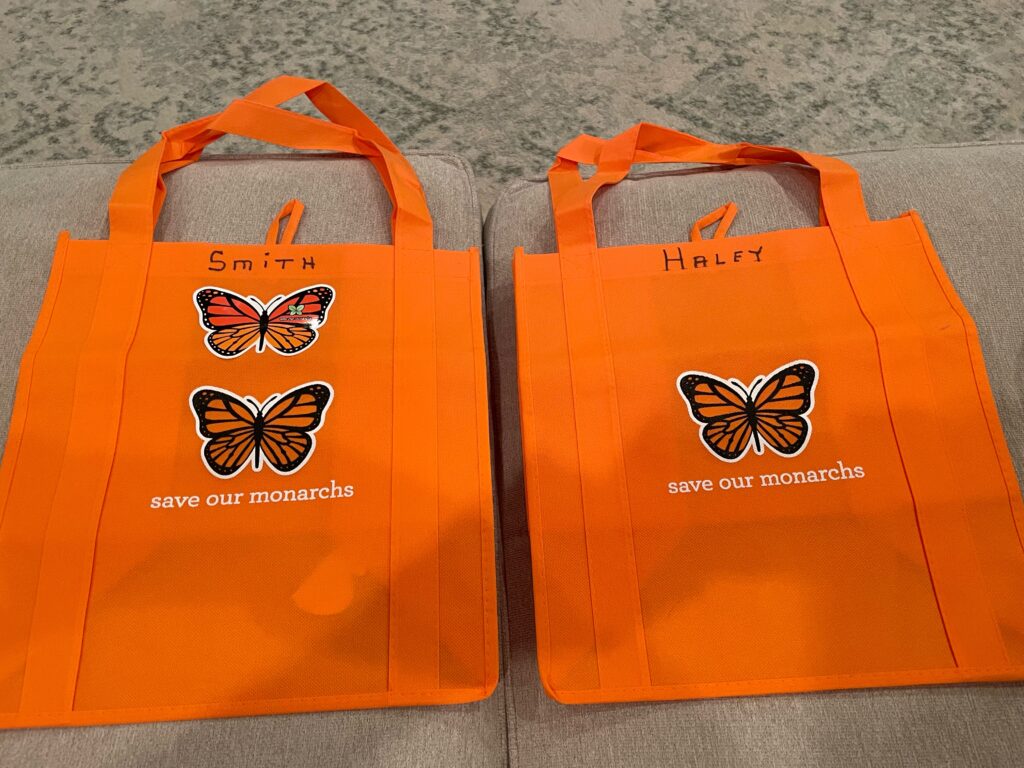
Choose gifts like “Save Our Monarchs Eco-Friendly Tote Bags,” “Monarch Butterfly Pins,” “Monarch Butterfly Earrings,” “Monarch Butterfly Charms,” and a Silver Christmas Tree Ornament with Save Our Monarchs imprinted in green. Go to:
https://www.saveourmonarchs.org/store/c6/Save_Our_Monarchs_Gear.html
Reach out to donate@saveourmonarchs.org
(Monarchs drink nectar through a proboscis, a straw-like tongue that coils up when not in use)
MONARCH INSPIRATION: The Story
Gladys Johnson was a patient gardener and student of all things living. She and her husband, Irvin, lived in the small town of Clara City, Minn., a town with a population of 1,106, where they raised three sons.
(Folklore says the early migration of the Monarch Butterfly is a sign of a hard winter ahead.)
Gladys had nearly a hundred African violets indoors, but it was outside that her green thumb really shone. A member of a ladies’ garden club amusingly called The Happy Hoers, she grew many plants in her garden to attract butterflies, including asters, purple coneflowers, and Shasta daisies.
Gladys and Irvin especially loved the monarch butterflies that visited their backyard gardens every summer. They would be heartbroken to hear what’s happening to their populations today and know they would be proud of our efforts to save them.
(The average Monarch lives only up to six weeks, except for the migratory generation, which can survive up to eight months) (2)
Already concerned that the Monarch’s habitat was in danger, Irvin and Gladys spent their winter vacations driving their little pop-up camper down to Florida or Texas, planting milkweed seeds in parks and along the roadway.
After Gladys died, Irvin went to Mexico, where Monarchs hibernate in the winter. There, he planted Oyamel fir trees to shelter the dormant Monarchs until they wake in the spring to begin the life cycle once again.
We are inspired by Irvin and Gladys and their efforts to help save the Monarch Butterfly.
The Save Our Monarch Foundation is dedicated to Irvin and Gladys. We believe the only way to save our Monarchs is the same way they did: getting our fingernails dirty and planting one milkweed plant at a time.
They are my Mom and Dad. May they Rest In Peace.
Ward Johnson
Founder, Save Our Monarchs
(The name “Monarch” is thought to honor King William III of England, also known as the Prince of Orange)