

Training Load
Life begins and ends at the cellular level.
Lifestyles are determined by habit. The most insidious aspect of habit is its ability to dull awareness. This is when the mayhem begins…
Training load refers to the cumulative stress an athlete experiences during exertion.
External load refers to the quantifiable metrics of a training session.
Internal load refers to the physiological and psychological responses to the workload.
Training Load Components
* External Training Load:
→ Distance;
→ Intensity;
→ Weight;
→ Repetitions and Sets;
→ Training Frequency;
→ Duration;
→ Rest Periods
* Internal Training Load:
→ Heart Rate;
→ Heart Rate Variability;
→ Rate of Perceived Exertion (RPE);
→ Muscle Soreness;
→ Muscle Fatigability;
→ Stress Response
* Training Load Benefits:
→ Real-Time Monitoring;
→ Quick Recovery Test;
→ Remote Training and Recovery;
→ Data Export;
→ API Integration;
→ Daily Stress and Sleep Analytics;
→ Movement Load and Intensity;
→ Prevent Overload and Overtraining;
→ Optimizing Performance;
→ Personalized Training

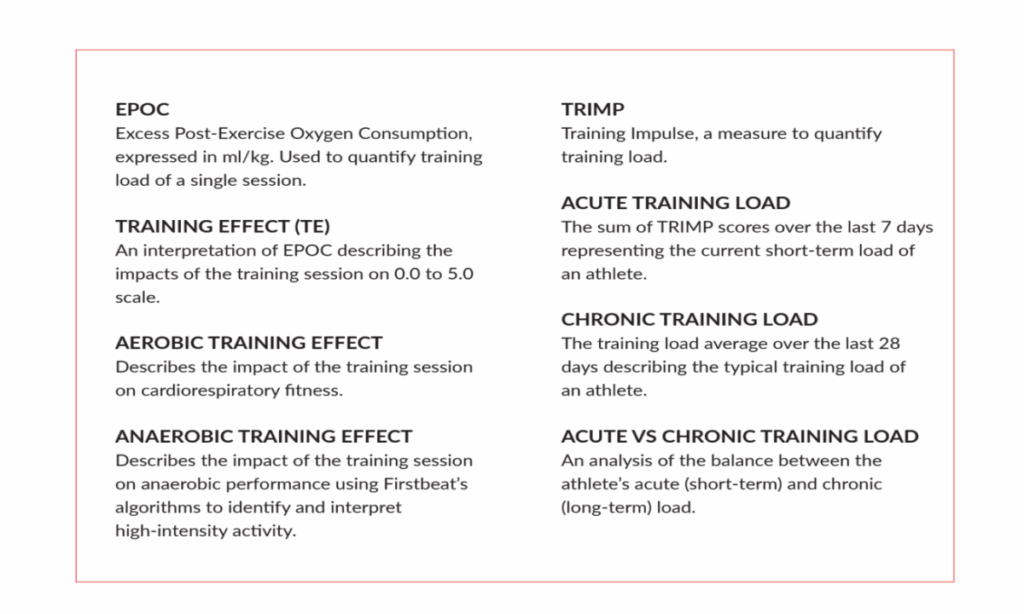
The Acute Chronic Workload Ratio [ACWR] is a ratio used in sports science to assess the balance between an athlete’s recent training load [acute workload] and their training load over an extended period [chronic workload].
ACWR is a metric used to assess training load and injury risk. It is calculated by dividing an athlete’s acute workload by their chronic workload.
A ratio between 0.8 and 1.3 is generally considered the “sweet spot” for training, indicating a balance between fatigue and fitness, while ratios above 1.3 or below 0.8 can signal increased injury risk or undertraining.
* Methodology:
→ Acute Workload: This represents the “fatigue” component of training, measuring the load or effort completed in a short timeframe;
→ Chronic Workload: This reflects the “fitness” component, indicating the athlete’s sustained fitness level during a specific time – usually a 3-6 weeks;
→ The Ratio: By comparing the recent load [acute] to the long-term average [chronic], the ACWR helps coaches and athletes understand how quickly their training load is changing. The ACWR is calculated by dividing the acute and chronic workloads.
* Ratio Metrics:
→ Optimal Training: A ratio between 0.8 and 1.3 (or 1.0-1.2 in some models) suggests the athlete is well-prepared, building fitness, and minimizing injury risk;
→ High Injury Risk: A ratio above 1.3 or 1.5 may indicate the training load is increasing too rapidly, potentially overloading the body and increasing the risk of injury;
→ Undertraining: A ratio below 0.8 could suggest the athlete is undertraining or not sufficiently building their fitness base, which can also lead to injury when sudden increases in load occur.
* Importance:
→ Injury Prevention: The ACWR is a tool for coaches to manage training loads and prevent load-driven injuries, helping athletes avoid the pitfalls of rapid spikes or decreases in training;
→ Performance Optimization: By monitoring the ACWR, coaches can balance training to foster adaptation and improve performance while minimizing the risk of preventable injuries;
→ Training Load Management:
Assists coaches and athletes to understand if they are training too hard or too little compared to their previous training history.
The ACWR is a method for coaches and athletes to assess and manage training load effectively in the spirit of preventing injuries and optimizing performance.
Growth has no endpoint…
We have the technology to eliminate guesswork, decode superhuman, and propel your limitless potential. Challenge yourself today to boldly manifest the keys to your mansion of unparalleled health, performance, and longevity.
A limitless life is a choice…
Find more information at Performance Medicine™.
Schedule a FREE CONSULTATION via the blue widget, our contact form, or 401.207.4215.