

Resilience Optimized
“Your genes may load the gun, but your lifestyle pulls the trigger.”
– Julieanna Hever, MS, RDN, CPT
__________________
Life begins and ends at the cellular level.
Lifestyles are determined by habit. The most insidious aspect of habit is its ability to dull awareness. This is when the mayhem begins…
Stress is an inescapable and universal human experience, and responses to repeated or prolonged stressors do not always follow a uniform course.
There is an art and science to resilience in life and sport.
Resilience refers to positive adaptation, or the ability to maintain or regain mental health, despite adversity. Resilience is often characterized as a process and an outcome.
It is the process and outcome of successful adaptation to physiological, psychological, social, and environmental challenges in life and sport – especially behavioral flexibility to internal and external demands.
Endurance athletes are no doubt familiar with physiological resilience. The fixation on how much pain one can endure represents a fraction of the comprehensive pillars of resilience, applicable to life and sport.
Endurance performance is primarily determined by three key physiological pillars:
→ Maximal Oxygen Uptake (VO2max);
→ Anaerobic Threshold;
→ Movement Economy
VO2max
Maximal oxygen consumption (VO2max) measures the maximum amount of oxygen the body can use during intense physical exertion. This measurement is generally considered the best indicator of cardiovascular fitness and aerobic endurance.
VO2max reflects your body’s potential oxygen uptake, or how much oxygen it can absorb and use while getting pushed to the limit during a workout.
→ V = Volume;
→ O2 = Oxygen;
→ Max = Maximum
The first pillar of endurance training is VO2max. Endurance sports performance depends on the availability of oxygen, carbohydrates, fats, and mitochondrial density.
VO2max is expressed as the number of milliliters of oxygen your body uses per kilogram of body weight per minute of exercise – measured as mL/kg/min.
Maximal oxygen consumption (VO2max) is one of the primary determinants of endurance sports performance, as it sets the upper limit for aerobic energy production and an athlete’s ability to sustain prolonged effort.
VO2max represents the highest rate at which the body can absorb, transport, and utilize oxygen during intense exercise.
To sustain ATP ( adenosine triphosphate) production via aerobic pathways, the body must optimize oxygen uptake, transport, and utilization, which involves adaptations in capillary density, mitochondrial quantity, aerobic enzyme activity, and cardiovascular efficiency
This pillar reveals your body’s potential power supply. Each inhalation and exhalation fuels a metabolic reaction within your muscle cells. This process provides your muscles ATP.
More oxygen input means more energy output.
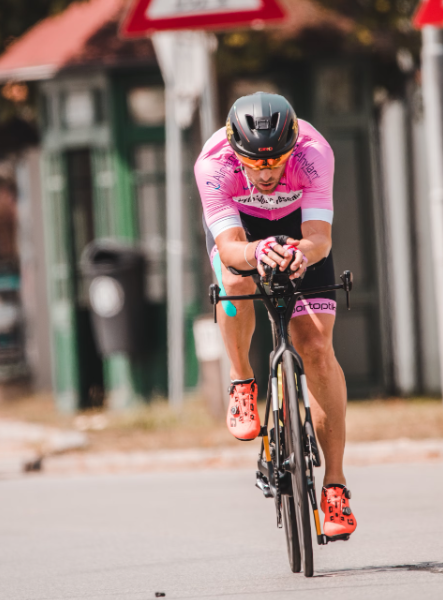
Anaerobic Threshold | AnT
AnT represents the maximum intensity at which aerobic metabolism still predominates. The anaerobic threshold is the highest exercise intensity that you can sustain for a prolonged period without lactate substantially building up in your blood.
The AnT, mistakenly referred to as lactate threshold (LT), is the point at which lactate begins to accumulate faster than it can be cleared, indicating a shift to anaerobic energy production. Training at or slightly above this threshold improves an athlete’s ability to sustain higher intensities and delays fatigue.
AnT and LT are often used interchangeably by coaches, trainers, and athletes when measuring and assessing an important endurance benchmark – the elusive physiological transition from aerobic to anaerobic energy production (AAT).
The difference between aerobic and anaerobic is the oxygen your body uses to produce ATP. Tracking and training your AAT is fundamental to optimizing endurance sports performance. The interest in the AAT shift during endurance exertion has heightened exponentially.
The scientific distinction between the concepts lies in the testing protocols respective to the foregoing transition. LT represents the accumulation point of the transition, while AnT represents the point of fatigue. LT is measured via blood/lactate testing, and AnT incorporates oxygen testing/gas exchange (O2 and CO2 levels).
Endurance athletes tend to have their AnT level close to their VO2max. To achieve this, it is necessary to increase the maximum fat oxidation capacity of skeletal muscle. Fat oxidation rates are closely linked to AnT.
VO2max represents the maximal aerobic capacity and is primarily limited by oxygen transport. Endurance sports performance is determined by VO2max and an athlete’s ability to sustain high-intensity effort. The AnT plays a crucial role in this context because it represents measurable aerobic power and the muscle’s ability to utilize oxygen to produce ATP.
Movement Economy | ME
The third pillar of endurance training is the ME. It is defined as the amount of energy required to perform a submaximal effort. Various factors influence it, including training type, training cycle phase, strength training, and environmental conditions.
ME is one of the most powerful and most misunderstood determinants of endurance performance. It highlights why two athletes with similar VO₂ max values can produce vastly different race outcomes.
The endurance athlete with superior ME requires a lower percentage of their maximum capacity to maintain a race pace. This delays the onset of fatigue and spares glycogen stores.
ME refers to how much energy an athlete expends to maintain a given speed or workload. It measures how efficiently the body converts metabolic energy to propel forward motion. ME is a cardiovascular element flanked by neuromuscular physiology, skeletal muscle, and related anatomical characteristics.
An athlete with efficient ME uses less oxygen, produces less waste, and experiences less physiological stress at the same pace compared to a less economical athlete.
The ME is strongly dependent on the ability of muscle fibers to generate and sustain movement with minimal energy cost. Endurance athletes typically have a higher proportion of type I muscle fibers, which generate optimal oxidative capacity, greater mitochondrial density, and increased capillarization.
Type II fibers play a crucial role in endurance performance. The ability of these fibers to efficiently meet energy demands during endurance activities can be influenced by genetic expression, which directly impacts ME.
Efficiency – not effort – determines endurance success. Biomechanics is just one of the keys. It examines the internal and external forces (breath, posture, gait…) acting on the body and the biological effects of these forces from the cellular level to human athletic performance.
Read more about fat adaptation via metabolic efficiency training.
Physiological Resilience
Research has suggested physiological resilience as a potential fourth pillar.
Physiological resilience refers to an endurance athlete’s capacity to tolerate and adapt to unexpected fatigue, stress, pain, and other demanding environmental factors that play crucial roles in ultra-endurance events.
Endurance sports performance is not only about achieving high physiological efficiency—it is also about sustaining it over time. This ability to resist performance decline despite accumulating fatigue and pain has been increasingly
While a high V̇O₂ max is nice, physiological resilience dictates how efficiently your body adapts to and uses its limited energy stores when fatigue becomes present. Fat adaptation is the key.
While the role of epigenetic factors in endurance sports performance has been widely studied, their influence on these pillars, particularly on fatigue resistance and long-term adaptation, remains an area of growing interest.
Find a few prominent genes associated with endurance sports performance.
Epigenetics
Epigenetics refers to how your behavior and environment can modify gene expression in life and sport. You must understand that your lifestyle influences gene expression.
Being fit but unhealthy is a recurring theme; it delineates effort from struggle in life and sport. Epigenetics is directly correlated to the pillars of resilience. Resilience can be fostered at the cellular level.
The keys to your mansion of unparalleled health, performance, and longevity are heightened when lifestyle matches chronotype. Performance optimization cannot occur without first enhancing health. Homeostasis is the dynamic interaction between genetics and lifestyle (nature and nurture). Synergy is the lynchpin.
Epigenetics represents an unprecedented, bold medical paradigm that leverages cutting-edge technology to shift your genetic expression, delivering mind-blowing results in life and sport.
Epigenetics provides visionary, incisive, evidence-based measures and strategic actions to genetically optimize and enhance health, performance, and longevity – because life begins and ends at the cellular level.
Epigenetic biomarkers (such as DNA methylation or histone modifications) are cellular signatures that interface and impact physiological, psychological, relational, and environmental resilience.
Systems Approach
It is necessary to integrate a complex systems approach to optimize health, performance, and longevity. It is essential to understand that the human system is unpredictable and complex, rather than complicated.
The human system is adaptive and dynamic. App algorithms focus on complicated, predictable, and static biometrics.
The invaluable art of applying complicated data to complex thinking is “augmented intelligence.” The precise interpretation of complicated data is the key to transcending health, performance, and longevity in life and sport.
“Change is a process, not an event.”
~James Prochaska
The art and science of resilience encompasses facets beyond the fortitude necessary to complete an ultra-endurance endeavor at altitude amid dehydration, fatigue, and blood-soaked apparel, gear, and limbs. There are “subtle” yet crucial aspects of resilience in the spirit of the optimized human that often go unnoticed.
Enter Michael D. Ostrolenk, MA, MFT, Master Coach in Resilience, Leadership, and Elite Performance.
Ostrolenk is undeniably the resilience guru, given his far-reaching expertise and the breadth of his experience changing lives.

Willpower matters.
But the conditions you build matter more.
For more than 30 years, Ostrolenk has seen lasting change come from four interconnected pillars. Amplified grit is not the answer. Engineering the conditions that make the right behavior the natural one is the key.
None of the pillars operate independently. All pillars influence one another. Improvements in one domain often cascade into improvements, or deterioration, in others.
This interconnection represents the foundation of Ostrolenk’s model.
Transformation is about breakthroughs. Formation engineers daily conditions that quietly produce an optimized human being. Ostrolenk’s life’s work is focused on formation.
Pillar 1: Physiological
Physiological resilience is the body’s ability to resist functional decline and recover homeostasis when exposed to acute or chronic stressors.
At the cellular level, physiological resilience highlights your body’s ability to rebound from stressors and represents a key biological marker of healthspan and longevity.
At a systemic level, it describes the body’s ability to adapt to environmental extremes without a collapse in biological function. It encompasses thermoregulation, metabolic efficiency, and tissue repair.
Balancing one’s daily allostatic load is vital to this pillar (see the synopsis below).
Pillar 2: Psychological
This pillar is built on nervous system regulation, somatic awareness, spiritual development, character, and mindset.
These levers primarily focus on conduct versus insight.
Psychological resilience is the dynamic, adaptive ability to cope mentally and emotionally with crisis, trauma, or adversity, and successfully return to or maintain a healthy level of functioning.
It is not a fixed personality trait; rather, a skill set that can be cultivated and strengthened over time through self-talk and a commitment to shift from a “fixed” to a “growth” mindset (see the synopsis below).
Pillar 3: Relational | Social
Strong social bonds attenuate your body’s stress reactions and lower the risk of depression. Studies have shown that a lack of meaningful social connection can be as detrimental to your physical health as smoking or obesity.
Family, workspace, and social groups play vital roles in facilitating a growth mindset. Consistent interaction with like-minded people ignites support, accountability, intellectual, and spiritual cultivation.
Cohesion is imperative to resilience and is built collaboratively on trusted relationships, community networks, and mutual empathy (see the synopsis below).
Pillar 4: Environmental
Your environment must foster the type of person you wish to become. It is necessary to understand whether your environment supports your values, habits, and fiber of your being, versus stifling creativity.
Cleansing aspects that detract from a growth mindset is imperative. Resilient ecosystems provide critical growth-oriented services, such as lighting, cosmetics, food, carbon sequestration, clean water filtration, and air purification, to foster a growth mindset.
An environmental focus shifts one’s mindset from reactive to proactive, fostering the creation of long-term, sustainable habitats that maintain their core functions while adapting to meet new challenges.
Modifications to induce growth represent the keys to one’s environmental sanctuary (see the synopsis below).
Formation over transformation.
Conduct over insight.
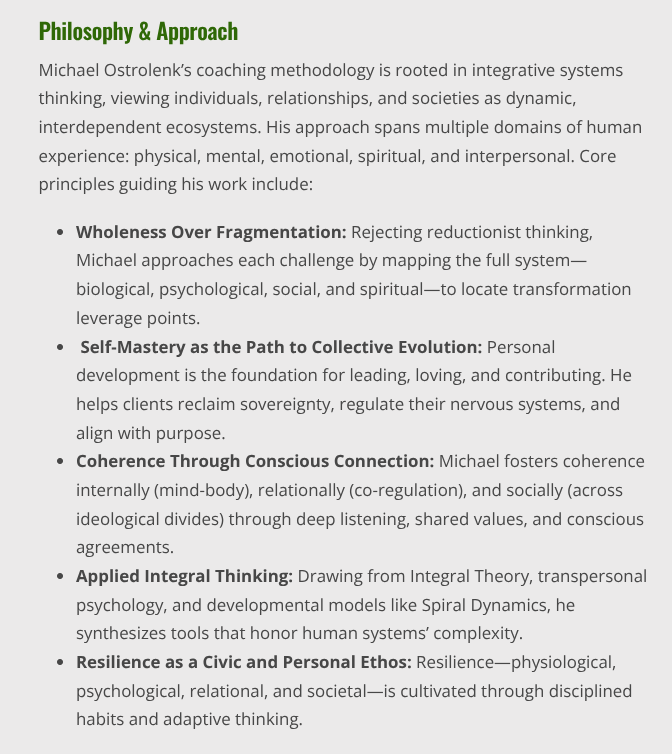
The Optimized Human
Awareness is the key.
Optimal health, unparalleled performance, and enhanced longevity in life and sport represent inside-out propositions.
Change, adapt, and grow becomes the maxim. Resilience is a systemic approach to self-actualization. The defining aspect of the four pillars of resilience is the interconnectedness of seemingly disparate elements. Understanding the art and science of resilience is priceless.
To learn more about the coveted Optimized Human Program that rewires your biology, sharpens your mind, strengthens your relationships, and tunes your environment into a high-performance command center, click here.
This changes everything…
Find below a synopsis of Ostrolenk’s philosophy.
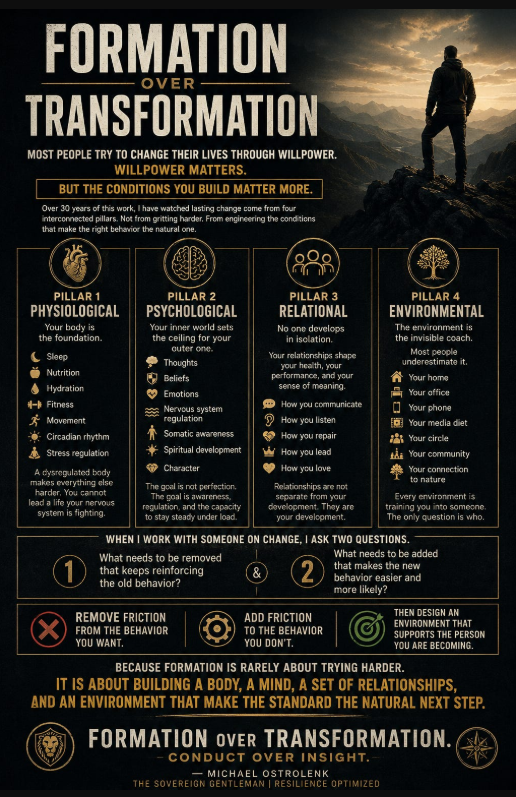
Ostrolenk has spent more than three decades integrating physiology, psychology, relationships, and environmental design into an applied resilience framework used with executives, athletes, physicians, couples, and military professionals.
Find more information below:
Growth has no endpoint…
We have the technology to eliminate guesswork, decode superhuman, and ignite your limitless potential. Challenge yourself today to boldly manifest the keys to your mansion of unparalleled health, performance, and longevity in life and sport.
A limitless life is a choice…
Find more information at Performance Medicine™.
Schedule a FREE CONSULTATION via the blue widget, our contact form, or 401.207.4215.